20x36x4 Air Filters: Why the Actual Size Differs
Lay a tape measure across a brand-new 20x36x4 air filter, run it down each side, and the numbers come up short. The cardboard frame measures roughly 19.5 by 35.5 by 3.625 inches, not the round number printed on the box. That undersizing trips up most homeowners the first time they swap a filter, and the assumption is almost always the same: the factory got it wrong. The factory didn't get it wrong. In our experience working with homeowners across the country, those smaller actual dimensions are the whole reason your filter seats properly inside the housing instead of buckling, bowing, or letting unfiltered air slip around the edges.
TL;DR Quick Answers
20x36x4 Air Filters
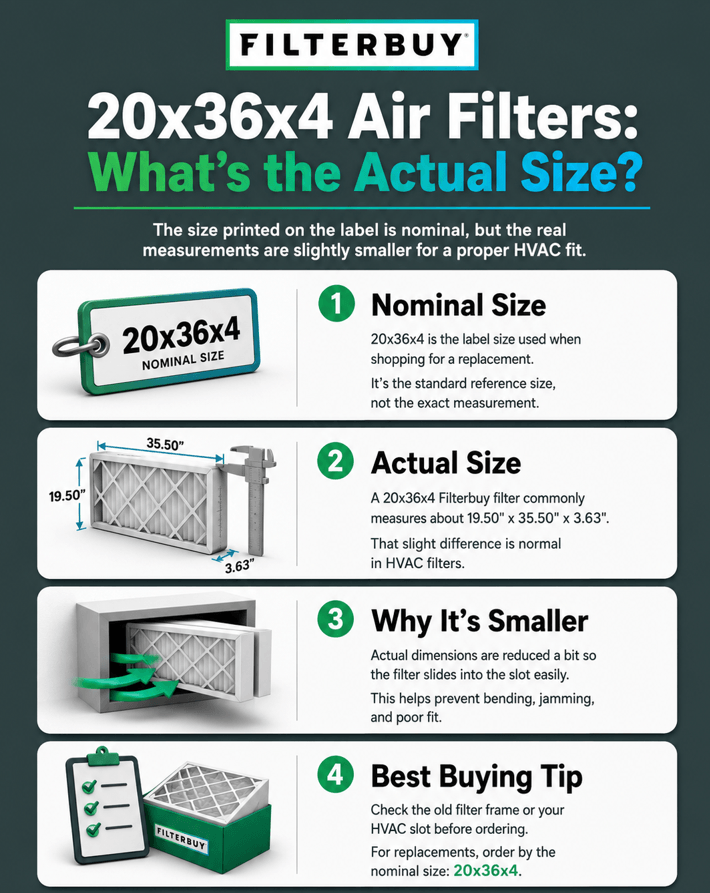
A 20x36x4 air filter carries a nominal label of 20 by 36 by 4 inches. The cardboard frame actually measures closer to 19.5 by 35.5 by 3.625 inches. Every major brand, Filterbuy included, builds residential filters slightly smaller than their printed label on purpose.
Quick facts for shoppers:
The number on the box, 20 by 36 by 4, is the nominal size used to order and shop.
The tape-measure number, about 19.5 by 35.5 by 3.625, is the actual frame size that has to fit your housing.
That smaller actual size lets the filter slide in cleanly without binding the pleats or breaking the seal.
A 4-inch filter only fits a housing built for a 4-inch slot, so confirm the depth before swapping between 1, 2, and 4-inch versions.
MERV 8, 11, and 13 change what the filter captures, not how big the filter is.
Top 5 Takeaways
Nominal size is the printed label you order by. Actual size is what shows up when you put a tape on the cardboard frame.
A 20x36x4 air filter typically measures about 19.5 by 35.5 by 3.625 inches in actual dimensions.
The intentional undersizing prevents air bypass at the seal and damage to the pleats during insertion.
The 20x36 root size also comes in 1-inch and 2-inch depths, so confirm the depth your system actually needs.
MERV rating changes how much the filter captures, not how big the filter is.
Nominal Size Versus Actual Size Of A 20x36x4 Air Filter
Two numbers describe every air filter on the market. The nominal size is the rounded label printed on the box, used across the industry so shoppers can compare brands and order without thinking in fractions. The actual size is the measured size of the cardboard frame, which manufacturers cut a fraction smaller than the label to fit a standard housing. Filterbuy uses the same nominal-to-actual relationship as every other major brand. A 20x36x4 from one supplier should match a 20x36x4 from another within a few hundredths of an inch.
You can shop between Filtrete, Filterbuy, HDX, Flanders, EZ Flow, and Arm and Hammer, and expect the actual dimensions to fall within a tight range of each other. Variation happens at the margin, and it matters most for 4-inch media filters that have to seat inside a fixed cabinet without play.
For a plain-English background on what an air filter actually does inside an HVAC system, the Wikipedia article on the air filter covers media types, pleat construction, and how particle capture works at the fiber level.
Why The Industry Builds Filters Slightly Undersized
Three things explain the gap between the label and the cardboard frame, and all three protect your air quality and your equipment.
Housing tolerance. Your filter slot was also built to a nominal opening with its own manufacturing tolerance. A filter cut to exactly 20 by 36 inches would jam against the rails, bow in the middle, or tear at the corners during installation.
Pleat protection. The pleated media inside the frame is what actually filters your air. A tighter fit during insertion would crush those pleats, which cuts the filter's effective surface area and shortens its life.
Frame swelling. Cardboard frames absorb humidity over time, especially in Florida homes and other warm, humid climates. The small starting clearance gives the frame room to expand without buckling or losing its seal.
In our experience working with homeowners across the country, fit problems almost always come from a slot built to non-standard dimensions, not from a filter that is the right nominal size for that slot. The actual undersizing is doing its job in the background.
How To Measure For A 20x36x4 Replacement
Confirming the right size before you order takes about ninety seconds with a tape measure. Here is the order we recommend when customers call us unsure about a replacement:
Slide out your existing filter and read the nominal size printed on the cardboard frame. The label that reads 20x36x4 means the air filters were sold under that nominal size, regardless of their actual measured dimensions.
Lay the old filter flat on a clean surface and run your tape along each outer edge. Write down the actual length, width, and depth. Expect numbers close to 19.5, 35.5, and 3.625 inches.
Measure the inside of the empty filter housing in your air handler or furnace. The slot opening should run roughly 20 by 36 inches, with about 4 inches of depth available.
Note the airflow arrow direction printed on the side of the old filter. The arrow points toward the blower. Your replacement gets installed the same way.
Cross-check your measurements against the filter listing before placing the order. A custom size is the right answer when the housing falls outside the standard tolerance window, and Filterbuy makes custom sizes to fit non-standard slots.
When A 20x36x4 Filter Is The Wrong Choice
A 20x36x4 air filter is the wrong call in a few specific situations. Most often, the system was built around the 20x36x1 or 20x36x2 root size, and a 4-inch filter physically can't seat inside a 1-inch or 2-inch slot. Sometimes the housing dimensions are non-standard and need a custom-cut filter to seal correctly. And sometimes the MERV rating chosen doesn't match the system's static pressure tolerance. High-MERV media restricts airflow more than a standard MERV 8, and some older systems struggle when pushed to MERV 13 without a duct review.
For households with allergies, pets, or recent attic insulation upgrades, MERV 11 often hits the right balance between particle capture and airflow stability. MERV 13 is the level the CDC and the EPA recommend whenever the system can support it, since it captures a meaningful share of particles in the 0.3 to 1.0 micron range.
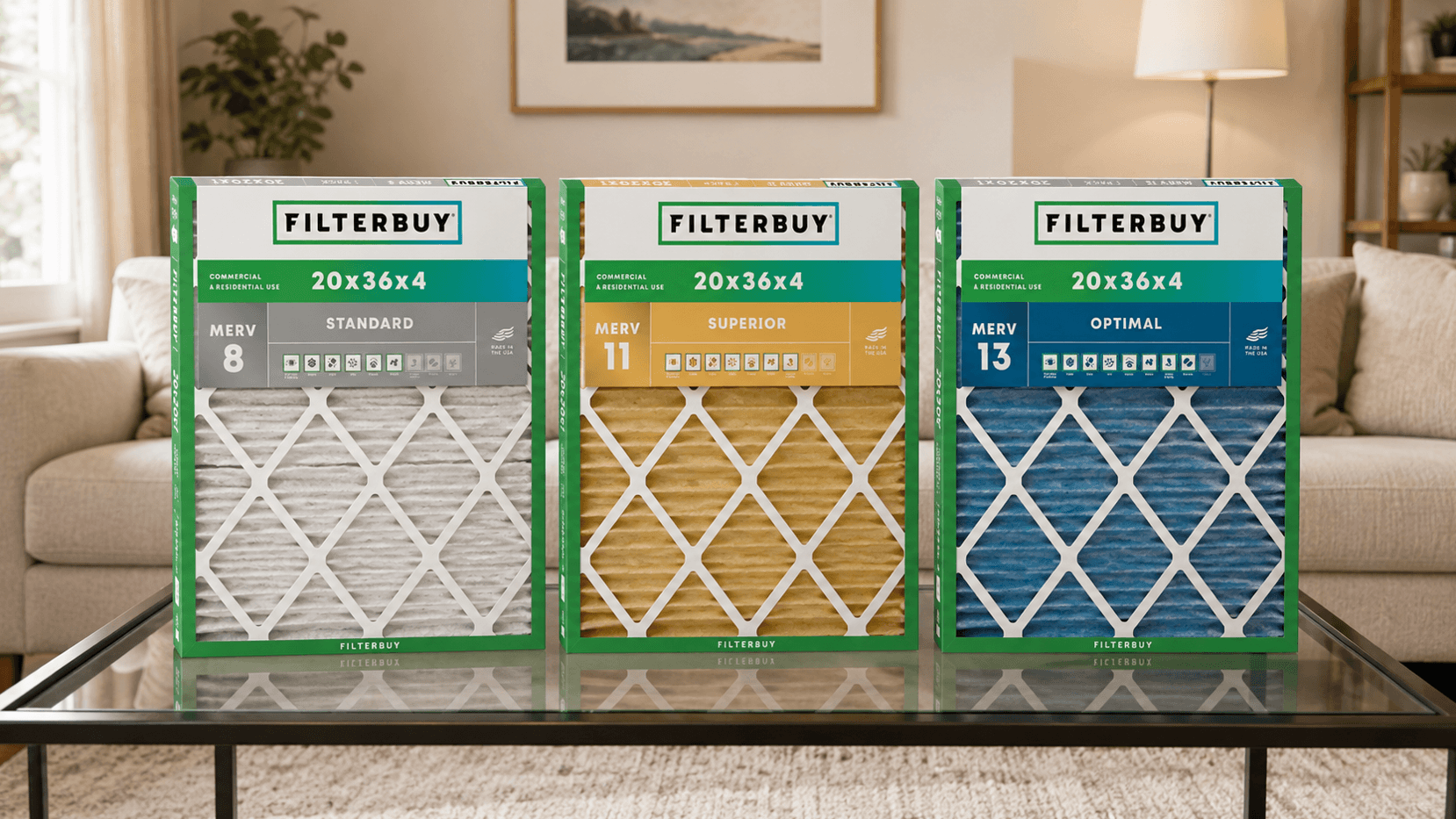
“After manufacturing filters for over a decade and serving more than two million households, the single most frequent sizing question we hear is why a 20x36x4 filter measures smaller than its label. The undersizing is deliberate. A filter that matches its nominal dimension exactly will not seat correctly, and a poor seat is what lets unfiltered air slip past the media.”
7 Essential Resources On 20x36x4 Air Filters
Sizing a 4-inch media filter is one piece of a larger picture. The resources below cover the federal guidance, industry standards, and household air quality context that surround a 20x36x4 purchase. Each link points to a specific article-level page on a unique .gov or .org domain.
1. Get The Federal Baseline On Home Air Cleaners
The EPA's Guide to Air Cleaners in the Home walks homeowners through what HVAC filters can and cannot remove from indoor air, with plain explanations of how filter size and seal quality affect overall performance.
Source: Guide to Air Cleaners in the Home, EPA
2. Learn How To Maintain The System Your Filter Lives In
The Department of Energy's Air Conditioner Maintenance guide details how regular filter replacement, proper airflow, and routine system care directly affect efficiency and equipment lifespan.
Source: Air Conditioner Maintenance, Department of Energy
3. See What The CDC Recommends For Cleaner Indoor Air
The CDC's guidance on cleaner indoor air recommends pleated HVAC filters and setting the system fan to “on” rather than “auto” when guests are over, so household air keeps moving through the filter at a higher rate.
Source: Taking Steps for Cleaner Air for Respiratory Virus Prevention, CDC
4. Read The Industry Standard Behind MERV Ratings
ASHRAE's filtration and disinfection resource covers the technical basis for every MERV number printed on a 20x36x4 box, including the 52.2 standard test method and why filter sealing matters as much as filter efficiency.
Source: Filtration and Disinfection Resources, ASHRAE
5. See How A Federal Lab Measures HVAC And Indoor Air Performance
NIST's Indoor Air Quality and Ventilation Group develops the measurement procedures and computer models that the HVAC industry uses to evaluate how filters and ventilation systems actually perform inside real homes. Their work informs the housing tolerances that explain why a 20x36x4 frame is built smaller than its label.
Source: Indoor Air Quality and Ventilation Group, NIST
6. Understand How Household Dust And Allergens Move Through The Home
The American Lung Association's Dust and Indoor Air Quality Briefing explains how dust mites, pet dander, and pollen circulate through indoor air, which is the load a properly sized 20x36x4 filter is built to capture.
Source: Dust and Indoor Air Quality Briefing, American Lung Association
7. Learn Why Filter Bypass Is The Industry's Top Concern
The National Air Filtration Association's Basics of Air Filtration page features expert-led video content on air filter bypass, which is the failure mode that the deliberate undersizing of a 20x36x4 frame is engineered to prevent.
Source: Basics of Air Filtration, NAFA
3 Supporting Statistics
These three figures place the cost of a poorly sized or poorly chosen 20x36x4 filter in real context. Each statistic comes from a specific article-level page on a federal or non-profit source, with no domain overlap with the resources section above.
1. ENERGY STAR Calls For Monthly Filter Inspections During Heavy-Use Months
ENERGY STAR recommends inspecting, cleaning, or changing air filters once a month in central air conditioners, furnaces, and heat pumps, especially during peak winter and summer use. A dirty filter slows airflow and forces the system to work harder, which raises energy bills and shortens equipment life. That cadence only matters if the filter actually fits inside its housing, since a poorly sized filter lets air bypass the media entirely.
Source: HVAC Maintenance Checklist, ENERGY STAR
2. High-Efficiency Residential Filtration Reduces Premature Mortality
Researchers Zhao, Azimi, and Stephens evaluated 11 filter classifications, MERV 5 through HEPA, across 22 U.S. cities in a peer-reviewed study housed at the National Library of Medicine. They estimated that widespread use of higher-efficiency residential filtration could reduce premature mortality from indoor fine particulate matter of outdoor origin by up to 2.5 percent, and could deliver monetary benefits of up to roughly 1,348 dollars per person per year. Both numbers depend on the filter actually fitting and sealing inside its housing.
3. Nearly One In Three U.S. Adults Live With A Diagnosed Allergic Condition
The Asthma and Allergy Foundation of America reports that more than 106 million people in the United States live with some form of allergic condition. Nearly one in three adults, along with more than one in four children, have a seasonal allergy, eczema, or food allergy. Pet dander, dust mites, and pollen all respond to a correctly sized, correctly seated HVAC filter.
Source: Allergy Facts, Figures, and Stats, AAFA
Final Thoughts And Opinion
The most expensive sizing mistake we see at Filterbuy isn't the wrong brand or the wrong MERV rating. It's a homeowner who trusts the box number, orders without measuring, and ends up with a filter that won't seal because the housing wasn't built to the same nominal opening the filter assumes. The fix takes ninety seconds and one tape measure.
Two habits prevent almost every fit problem we see:
Pull the old filter before you order. Run a tape down each side, write the actual numbers on a sticky note, and compare them to the listing on the product page.
Keep one spare filter in the closet at all times. The next change becomes a calm swap instead of a scramble or an emergency overnight order.
That habit works for any nominal size on the market, not only 20x36x4.
Frequently Asked Questions
Q: What Are The Exact Actual Dimensions Of A 20x36x4 Air Filter?
A: A 20x36x4 air filter typically measures about 19.5 inches by 35.5 inches by 3.625 inches in actual dimensions. The 20x36x4 label is the nominal size, which is a rounded industry naming convention used so shoppers can compare brands without thinking in fractions. The actual size is built slightly smaller on purpose, so the filter slides into a 20x36 housing without binding.
Q: Is A 20x36x4 Air Filter The Same As A 20x36 Air Filter?
A: Not quite. The 20x36 designation is the root size, which is sold in three common depths: 1 inch, 2 inches, and 4 inches. A 20x36x4 is the 4-inch version. It only fits a housing built to hold a 4-inch filter, so check the depth of your existing slot before swapping between depths.
Q: Should I Choose MERV 8, MERV 11, Or MERV 13 In A 20x36x4 Size?
A: The right answer depends on the household and the HVAC system. MERV 8 handles basic dust and lint and stays gentle on airflow. MERV 11 captures a higher share of pet dander, mold spores, and pollen, and is a common pick for homes with allergies or pets. MERV 13 captures finer particles in the 0.3 to 1.0 micron range and is the level the CDC and the EPA recommend whenever the system can support it. If you're unsure whether your system can handle MERV 13, start at MERV 11.
Q: How Often Should A 20x36x4 Air Filter Be Replaced?
A: A 4-inch pleated 20x36x4 filter generally lasts between six and twelve months in a typical residential system, far longer than a 1-inch filter. Households with pets, recent renovations, smokers, or active allergies should plan for the shorter end of that range. Inspect the filter at the three-month mark and replace it once it looks loaded with dust or once the airflow at the vents feels noticeably weaker.
Q: Where Can I Buy A 20x36x4 Air Filter Near Me, In Bulk, Or Online?
A: 20x36x4 air filters are sold at Home Depot, Lowe's, Walmart, Costco, Amazon, Ace Hardware, and direct from manufacturers like Filtrete, 3M, HDX, Flanders, EZ Flow, Arm and Hammer, and Filterbuy. Bulk packs are usually the lowest cost per filter. Direct-from-manufacturer ordering gives you access to custom sizes when a housing falls outside the standard 19.5 by 35.5 by 3.625 actual dimensions.
Q: How Do I Install A 20x36x4 Air Filter Correctly?
A: Turn off the HVAC system at the thermostat. Open the filter access door on the return air plenum, air handler, or furnace cabinet. Slide the old filter out and note the airflow arrow direction printed on its side. Slide the new 20x36x4 filter in with that same arrow pointing toward the blower or the duct. Close the access door and turn the system back on. The cardboard frame should sit flush against the housing with no visible gap on any side.
Find The Right 20x36x4 Filter For Your Home
Get a 20x36x4 that actually fits, in the MERV rating that matches your household, and the filter does the job it was built to do. For the bigger picture on how 4-inch filtration pairs with attic insulation to lift home efficiency, read the 5 advantages of MERV 13 furnace HVAC air filter and attic insulation installation in Delray Beach resource.
Learn more about HVAC Care from one of our HVAC solutions branches…
Filterbuy HVAC Solutions - Weston FL
2573 Mayfair Lane Weston FL 33327
(754) 296-3528
https://maps.app.goo.gl/E3tjmKf5VSWYghGc7